domingo, 12 de abril de 2020

SEMANA 1 A 5 JUNIO. PAST SIMPLE AND PAST CONTINUOUS. REVISION


SEMANA 1 A 5 JUNIO. PAST SIMPLE AND PAST CONTINUOUS. REVISION

2.        EXPLICACION: PASALA A TU CUADERNO
PAST SIMPLE

ESTRUCTURA:
Pasado Simple – (Simple Past Tense) | Aprender Inglés Fácil

PAST CONTINUOUS

ESTRUCTURA
Pasado Continuo – (Past Continuous) | Aprender Inglés Fácil
3.        

           EXERCISES
Put the verbs into the correct form (simple past).
1.     Last year I (LOVE)  my holiday in Ireland.
2.     It (SOUND)  great.
3.     (travel)  around by car with two friends and we (visit)  lots of interesting places.
4.     In the evenings we usually (VISIT)   a pub.
5.     One night we even (STUDY)  some Irish dances.
6.     We (be)  very lucky with the weather.
7.     It (not / rain)  a lot.
8.     But we (WATCH)  some beautiful rainbows.
9.     Where (ENJOY/ you)  your last holiday?

Put the verbs into the correct form (past progressive).
1.     When I phoned my friends, they (play)  monopoly.
2.     Yesterday at six I (prepare)  dinner.
3.     The kids (play)  in the garden when it suddenly began to rain.
4.     (practise)  the guitar when he came home.
5.     We (not / cycle)  all day.
6.     While Aaron (work)  in his room, his friends (swim)  in the pool.
7.     I tried to tell them the truth but they (listen / not) .
8.     What (you / do)  yesterday?
9.     Most of the time we (sit)  in the park.

4.        CORRECTIONS: COMPRUEBA TUS EJERCICIOS Y CORRIGE LOS ERRORES
Put the verbs into the correct form (simple past).
10.   Last year I (LOVE)  my holiday in Ireland. LOVED- EL AÑO PASADO ME ENCANTARON MIS VACACIONES EN IRLANDA.
11.   It (SOUND)  great. SOUNDED. SONÓ GENIAL
12.   (travel)  around by car with two friends and we (visit)  lots of interesting places. TRAVELLED/ VISITED- YO VIAJÉ EN COCHE CON DOS AMIGOS Y NOSOTROS VISITAMOS MUCHOS LUGARES INTERESANTES.
13.   In the evenings we usually (VISIT)   a pub. VISITED- POR LAS NOCHES NOSOTROS USUALMENTE VISITAMOS UN PUB.
14.   One night we even (STUDY)  some Irish dances. STUDIED- UNA NOCHE INCLUSO ESTUDIAMOS ALGUNOS BAILES IRLANDESES.
15.   We (be)  very lucky with the weather. WERE- FUIMOS MUY AFORTUNADOS CON EL TIEMPO.
16.   It (not / rain)  a lot. DIDN’T RAIN- NO LLOVIÓ MUCHO.
17.   But we (WATCH)  some beautiful rainbows. WATCHED- PERO NOSOTROS VIMOS ALGUNOS ARCO IRIS MUY BONITOS.
18.   Where (ENJOY/ you)  your last holiday? DID YOU ENJOY- DONDE DISFRUTASTEIS VUESTRAS ULTIMAS VACACIONES?

Put the verbs into the correct form (past CONTINUOUS).
10.   When I phoned my friends, they (play)  monopoly. WERE PLAYING- CUANDO LLAMÉ A MIS AMIGOS, ELLOS ESTABAN JUGANDO AL MONOPOLI.
11.   Yesterday at six I (prepare)  dinner. WAS PREPARING- AYER A LAS SEIS, YO ESTABA PREPARANDO LA CENA.
12.   The kids (play)  in the garden when it suddenly began to rain. WERE PLAYING- LOS NIÑOS ESTABAN JUGANDO EN EL JARDIN CUANDO DE REPENTE EMPEZO A LLOVER.
13.   (practise)  the guitar when he came home. WAS PRACTISING- YO ESTABA PRACTICANDO EN LA GUITARRA CUANDO EL VOLVIÓ A CASA.
14.   We (not / cycle)  all day. WERE NOT CYCLING- NOSOTROS NO ESTUVIMOS MONTANDO EN BICI TODO EL DIA.
15.   While Aaron (work)  in his room, his friends (swim)  in the pool. WAS WORKING/ WERE SWIMMING- MIENTRAS AARON ESTABA TRABAJANDO EN SU HABITACIÓN. SUS AMIGOS ESTABAN NADANDO EN LA PISCINA.
16.   I tried to tell them the truth but they (listen / not) . WERE NOT LISTENING- YO INTENTE CONTARLES LA VERDAD PERO ELLOS NO ESTABAN ESCUCHANDO.
17.   What (you / do)  yesterday? WERE YOU DOING- QUE ESTUVISTEIS HACIENDO AYER?
18.   Most of the time we (sit)  in the park. WERE SITTING- LA MAYORIA DEL TIEMPO ESTUVIMOS SENTADOS EN EL PARQUE.

WEEK 25TH- 29TH MAY: WILL AND GOING TO REVISION


SEMANA 25 AL 29 DE MAYO: WILL AND GOING TO. REVISION

1.         TURORIAL


2.        EXPLICACION: COPIALA EN TU CUADERNO

WILL
Future Tenses - Our English Corner-324
ESTRUCTURA
Presente simple vs continuo - Gramática interactiva - Ejercicios ...
3.        EXERCISES
Use will.
1.     You (earn)  a lot of money.
2.     You (travel)  around the world.
3.     You (meet)  lots of interesting people.
4.     Everybody (adore)  you.
5.     You (not / have)  any problems.
6.     Many people (serve)  you.
7.     They (anticipate)  your wishes.
8.     There (not / be)  anything left to wish for.
9.     Everything (be)  perfect.
10.   But all these things (happen / only)  if you marry me.
 Use going to.
1.     It (rain) .
2.     They (eat)  stew.
3.     (wear)  blue shoes tonight.
4.     We (not / help)  you.
5.     Jack (not / walk)  home.
6.     (cook / you)  dinner?
7.     Sue (share / not)  her biscuits.
8.     (leave / they)  the house?
9.     (take part / she)  in the contest?
10.   (not / spend)  my holiday abroad this year.

4.        CORRECCTIONS:COMPRUEBA TUS EJERCICIOS Y CORRIGE LOS ERRORES
Use will.
You (earn)  a lot of money. WILL EARN- GANARÁS MUCHO DINERO
You (travel)  around the world. WILL TRAVEL- VIAJARÁS ALREDEDOR DEL MUNDO
You (meet)  lots of interesting people. WILL MEET- ENCONTRARÁS MUCHAS PERSONAS INTERESANTES
Everybody (adore)  you. WILL ADORE- TODO EL MUNDO TE ADORARÁ.
You (not / have)  any problems. WILL NOT- NO TENDRÁS NINGÚN PROBLEMA.
Many people (serve)  you. WILL SERVE- MUCHAS PERSONAS TE SERVIRÁN.
They (anticipate)  your wishes. WILL ANTICIPATE- ELLOS ANTICIPARAN TUS DESEOS
There (not / be)  anything left to wish for. WILL NOT BE- NO QUEDARÁ NADA PARA DESEAR.
Everything (be)  perfect. WILL BE- TODO SERÁ PERFECTO
But all these things (happen / only)  if you marry me. WILL ONLY HAPPEN- PERO TODAS ESTAS COSAS SOLO OCURRIRÁN SI TE CASAS CONMIGO
 USE GOING TO.
It (rain) . IS GOING TO RAIN- VA A LLOVER.
They (eat)  stew. ARE GOING TO EAT- ELLOS VA A COMER POTAJE.
(wear)  blue shoes tonight. AM GOING TO WEAR- VOY A LLEVAR ZAPATOS AZULES ESTA NOCHE.
We (not / help)  you. ARE NOT GOING TO HELP- NO TE VAMOS A AYUDAR.
Jack (not / walk)  home. IS NOT GOING TO WALK- JACK NO VA A CAMINAR A CASA.
(cook / you)  dinner? ARE YOU GOING TO COOK- VAS A COCINAR LA CENA?
Sue (share / not)  her biscuits.- IS NOT GOING TO SHARE- SUE NO VA A COMPARTIR SUS GALLETAS.
(leave / they)  the house? ARE THEY GOING TO LEAVE- VAN ELLOS A SALIR DE CASA?
(take part / she)  in the contest? IS SHE GOING TO TAKE PART- VA ELLA A PARTICIPAR EN EL CONCURSO?
(not / spend)  my holiday abroad this year. AM NOT GOING TO SPEND- YO NO VOY A PASAR MIS VACACIONES EN EL EXTRANJERO ESTE AÑO.


SEMANA 18 AL 22 DE MAYO: PRESENT SIMPLE AND PRESENT CONTINUOUS. REVISION

1.        TURORIAL:


2.        TEORÍA: COPIALA EN TU CUADERNO
EL "SIMPLE PRESENT" SE UTILIZA:
  • Para expresar hábitos y rutinas, hechos generales, acciones repetidas o situaciones, emociones y deseos permanentes:
    I smoke (hábito); I work in London (permanencia); London is a large city (hecho general)
  • Para dar instrucciones o indicaciones:
    You walk for two hundred meters, then you turn left.
  • Para hablar de eventos programados, presentes o futuros:
    Your exam starts at 09.00.
  • Para referirse al futuro, detrás de algunas conjunciones: after, when, before, as soon as, until:
    He'll give it to you when you come next Saturday.
Present Simple | alicia2c
NOTAS SOBRE LA TERCERA PERSONA DEL SINGULAR DEL "SIMPLE PRESENT"
  • En la tercera persona del singular, el verbo siempre termina en -s:
    he wants, she needs, he gives, she thinks.
  • Para las formas negativa e interrogativa, se emplea DOES (= tercera persona del auxiliar 'DO') + el infinitivo del verbo.
    He wants ice cream. Does he want strawberry? He does not want vanilla.
  • Verbos que terminan en -y : en la tercera persona del singular, se cambia la -y por -ies:
    fly --> flies, cry --> cries
    Excepción: cuando una vocal precede a la -y:
    play --> plays, pray --> prays
  • Añadimos -es a los verbos que terminan en:-ss, -x, -sh, -ch:
    he passes, she catches, he fixes, it pushes
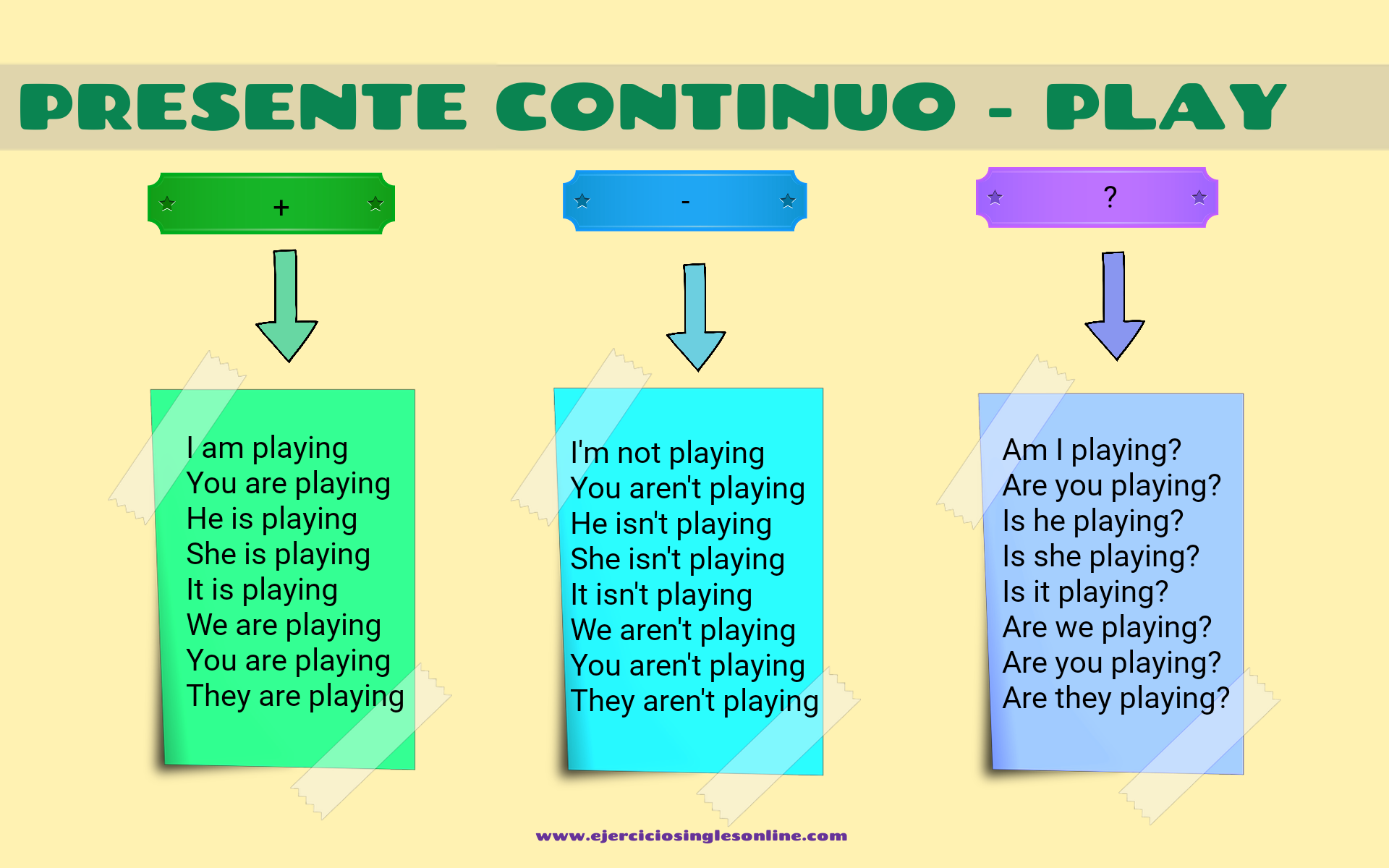
PRESENT CONTINUOUS
¿Para qué se usa? Para describir acciones que están ocurriendo en este momento, es decir, en el momento en el que se está hablando. También se puede usar para hablar del futuro, como explicamos en este otro artículo. De momento, vamos a centrarnos en el presente. ¿Cómo se forma? Con el verbo to be en presente simple (amisare) más el verbo principal en gerundio (terminado en –ing). La regla de oro es que el 99 % de las veces que lo usamos, contraemos al hablar. Ingles: Presente continuo
3.     EXERCISES
PRESENT SIMPLE
Affirmative Sentences
1.     (to like)  lemonade very much.
2.     The girls always (to listen)  to pop music.
3.     Janet never (to wear)  jeans.
4.     Mr Smith (to teach)  Spanish and French.
5.     You (to do)  your homework after school.
Negative Sentences.
1.     My father makes breakfast. → 
2.     They are eleven. → 
3.     She writes a letter. → 
4.     I speak Italian. → 
5.     Danny phones his father on Sundays. → 
Questions
1.     you / to speak / English → 
2.     when / he / to go / home → 
3.     they / to clean / the bathroom → 
4.     where / she / to ride / her bike → 
5.     Billy / to work / in the supermarket → 

PRESENT CONTINUOUS EXERCISES
Put the verbs into AFFIRMATIVE.
1.     My sister (to clean)  the bathroom.
2.     Look! They (to go)  inside.
3.     (to wait)  in the car now.
4.     Mrs Miller (to listen)  to CDs.
5.     We (to speak)  English at the moment.
Negative Sentences
1.     We are playing a game. 
2.     I'm drawing a picture. 
3.     He is making pizza right now. 
4.     Susan and her brother are taking photos. 
5.     Dad is working in the kitchen. 
Questions
1.     Robin / to ride / his bike - 
2.     where / she / to go - 
3.     what / your mother / to do / now - 

4.        CORRECTIONS: COMPRUEBA TUS EJERCICIOS Y CORRIGE LOS ERRORES
PRESENT SIMPLE
Affirmative Sentences
6.     (to like)  lemonade very much. LIKE- ME GUSTA MUCHO LA LIMONADA
7.     The girls always (to listen)  to pop music. LISTEN- LAS CHICAS SIEMPRE ESCUCHAN MUSICA POP.
8.     Janet never (to wear)  jeans. WEARS- JANET NUNCA LLEVA VAQUEROS.
9.     Mr Smith (to teach)  Spanish and French. TEACHES- EL SEÑOR SMITH ENSEÑA ESPAÑOL Y FRANCÉS.
10.   You (to do)  your homework after school. DO- TU HACES TUS DEBERES DESPUES DEL COLEGIO
Negative Sentences.
6.     My father makes breakfast. →  MI PADRE HACE EL DESAYUNO- MY FATHER DOESN’T MAKE BREAKFAST
7.     They are eleven. → ELLOS TIENEN 11 AÑOS- THEY ARE NOT ELEVEN
8.     She writes a letter. → ELLA ESCRIBE CARTAS- SHE DOESN’T WRITE A LETTER
9.     I speak Italian. → HABLO ITALIANO- I DON’T SPEAK ITALIAN
10.   Danny phones his father on Sundays. → DANNY HABLA POR TELEFONO CON SU PADER LOS DOMINGOS- DANNY DOESN’T PHONE HIS FATHER ON SUNDAYS
Questions
6.     you / to speak / English → DO YOU SPEAK ENGLISH?- HABLAS INGLÉS?
7.     when / he / to go / home à WHEN DOES HE GO HOME?- CUANDO VA EL A CASA?
8.     they / to clean / the bathroom → DO THEY CLEAN THE BATHROOM?- LIMPIAN ELLOS EL BAÑO?
9.     where / she / to ride / her bike à WHERE DOES SHE RIDE HER BIKE?- DONDE MONTA ELLA SU BICI?
10.   Billy / to work / in the supermarket → DOES BILLY WORK IN THE SUPERMARKET? TRABAJA BILLY EN EL SUPER MERCADO?

PRESENT CONTINUOUS EXERCISES
Put the verbs into AFFIRMATIVE.
6.     My sister (to clean)  the bathroom. IS CLEANING- MI HERMANA ESTA LIMPIANDO EL BAÑO
7.     Look! They (to go)  inside. ARE GOING- MIRA! ELLOS ESTÁN ENTRANDO.
8.     (to wait)  in the car now. AM WAITING- ESTOY ESPERANDO EN EL COCHE AHORA.
9.     Mrs Miller (to listen)  to CDs. IS LISTENING- LA SEÑORA MILLER ESTA ESCUCHANDO CDS
10.   We (to speak)  English at the moment. ARE SPEAKING- NOSOTROS ESTAMOS HABLANDO INGLÉS EN ESTE MOMENTO
Negative Sentences
6.     We are playing a game. ESTAMOS JUGANDO A UN JUEGO. WE ARE NOT PLAYING A GAME
7.     I'm drawing a picture. ESTOY DIBUJANDO UN CUADRO. I AM NOT DRAWING A PICTURE
8.     He is making pizza right now. EL ESTA HACIENDO PIZZA AHORA. HE IS NOT MAKING A PIZZA RIGHT NOW.
9.     Susan and her brother are taking photos SUSAN Y SU HERMANO ESTAN TOMANDO FOTOS- SUSAN AND HER BROTHER ARE NOT TAKING PHOTOS.
10.   Dad is working in the kitchen. MI PADRE ESTÁ TRABAJANDO EN LA COCINA- DAD IS NOT WORKING IN THE KITCHEN
Questions
1.Robin / to ride / his bike. IS ROBIN RIDING HIS BIKE? ESTÁ ROBIN MONTANDO EN SU BICI?
4.     where / she / to go . WHERE IS SHE GOING? DONDE ESTÁ YENDO ELLA?
5.        what / your mother / to do / now . WHAT IS YOUR MOTHER DOING NOW? QUE ESTÁ HACIENDO TU MADRE AHORA?